

I spent last week at HumanX in San Francisco. After dozens of conversations with operators across industries, two things became clear. First, agents are the new “hot thing.” And second, we’re still talking about AI like it’s one thing. It’s not; AI is a system. Agents are just one layer of that system — and without the layers beneath them, they don’t work.
This is the starting point for a series I’m calling “How to successfully implement AI.” Part 1 begins at the foundation: what AI is and how it actually works.
The simplest way to understand AI is as a six-layer stack, each layer building on the one below it.
The raw processing power. The hardware that runs everything.
Where data lives - systems, pipelines, storage. Most enterprises have already invested heavily here.
What most people call “AI.” Models can generate, analyze, and answer. But on their own, they’re stateless, inconsistent, and disconnected from your business. This is where most AI efforts stall.
This is the layer most companies skip, and the reason AI doesn’t work at scale or consistently. AI needs a shared understanding of what data means.
Without this layer, AI guesses and the likelihood of hallucinations is greater. With it, AI understands, reasons, and produces consistent, auditable outputs. Think about it… if you don’t have context, how would that affect your answer to a question?
This is where AI starts doing work. Systems coordinate models, move across workflows, and execute tasks — pulling actuals, reconciling data, flagging exceptions — without manual stitching.
Copilots, automation, decision tools. But this layer is only as good as what’s underneath it.
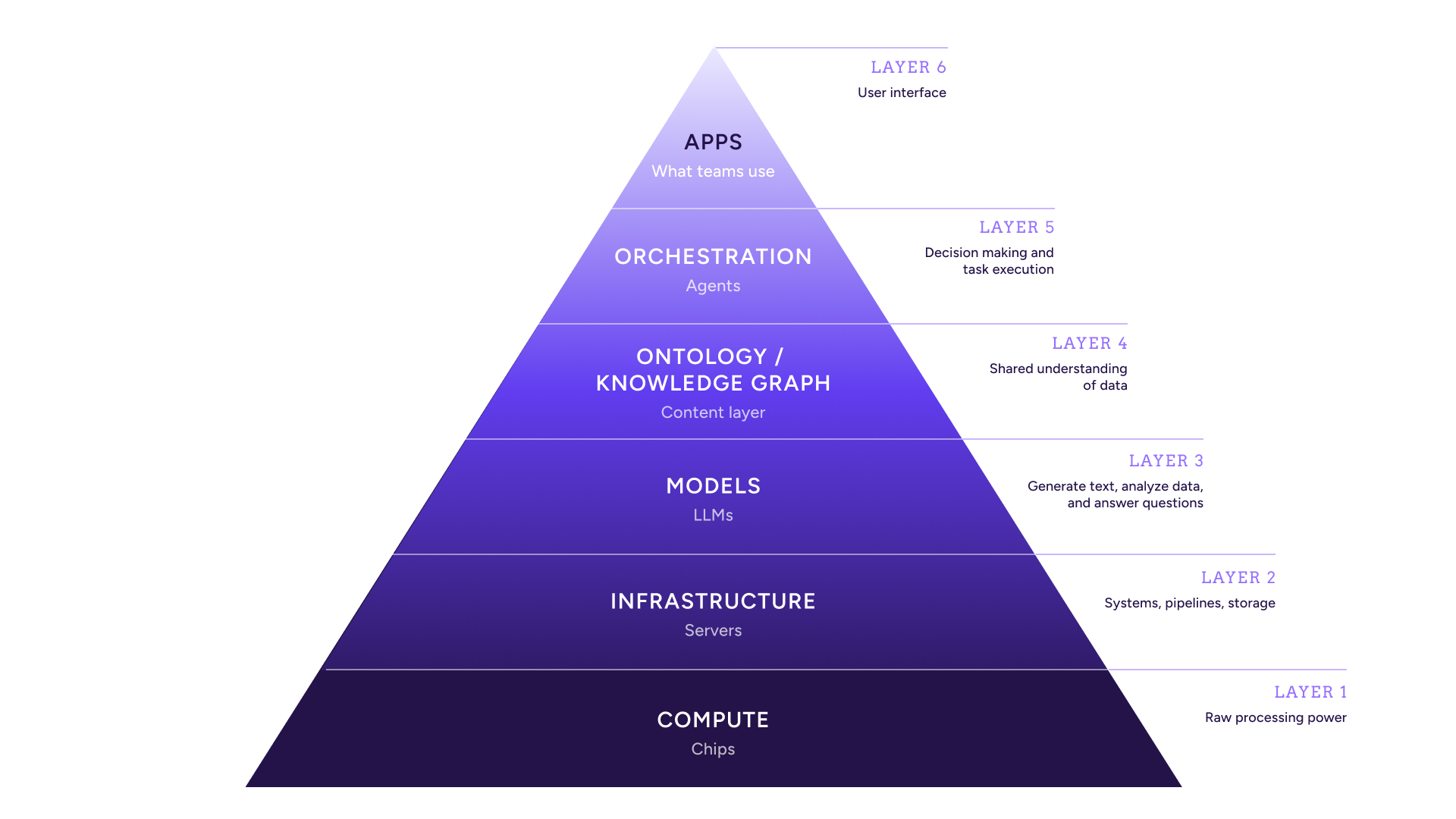
AI isn’t just a tool you experiment with; it’s an operating layer. In biopharma, that means handling complex clinical and financial relationships, operating in regulated environments, and producing outputs that are trusted, consistently reliable, and explainable.
When it works, the impact is real: speed and accuracy at precision levels impossible before, with full visibility across clinical and financial data.
At Condor, we’re building the contextual layer — a pharma-specific ontology and knowledge graph connecting clinical and financial data, embedded directly into operations, accruals, financial planning, and budgeting. It’s not another tool. It’s the intelligence layer that makes AI actually work across R&D and finance.


